What is margin in trading
Margin is a fundamental concept in trading, often misunderstood by beginners even though it lies at the heart of how modern markets work. Understanding margin means understanding how traders can take large positions with relatively limited capital, but also why the risks can be high.
A simple and essential definition
The margin is the amount of money you have to tie up in your account to open and maintain a position on the financial markets. It's not a cost or a commission, but rather a kind of security deposit.
In other words, margin is the minimum amount you commit to access a larger position thanks to another mechanism: leverage.
The relationship between margin and leverage
Margin and leverage are inseparable. They work together and cannot be understood separately.
The margin represents your committed capital
The leverage allows you to amplify the size of your position
In practical terms, leverage gives you access to greater exposure than your actual capital. Margin, on the other hand, is the prerequisite for access to this exposure.
For example, with a leverage of 30:1, this means that for every euro you commit (your margin), you can control 30 euros on the market.
If you have 100 euros in your account, you can then open a position of up to 3000 euros. The margin required for this position will therefore be 100 euros.
Understanding how margin trading works
Margin trading gives you access to opportunities that would otherwise be inaccessible with limited capital. This is what makes trading attractive to many individuals.
When you open a position, you only mobilize a fraction of its total value. This fraction is the margin. The rest is "provided" by the broker in the form of exposure.
This means that your gains and losses are not calculated on your initial capital, but on the total size of your position.
It's this point that makes margin both powerful and dangerous.
Concrete example to understand
Imagine you have 200 euros in your account and you use a leverage of 20:1.
You can then open a position of 4000 euros.
If the market moves in your favor by 1%, you gain 40 euros
If the market moves against you by 1%, you also lose 40 euros
Without leverage, this same movement would only have generated a gain or loss of 2 euros.
This example clearly shows that margin, combined with leverage, acts as a multiplier.
Why margin increases risk
Many beginners focus solely on the potential gains offered by margin and leverage. Yet the most important point to understand is that losses are amplified in the same way.
A seemingly small market move can have a significant impact on your capital.
The more leverage you use, the more you reduce your account's margin of safety. This means that a single adverse movement can be enough to put your positions at risk.
This is why margin trading is considered a high-risk activity.
Margin requirements
To maintain an open position, your account must meet a certain minimum funds level. This is known as the margin requirement.
Each financial instrument has its own rules regarding leverage and therefore the margin required.
For example, with a leverage of 30:1, the margin required corresponds to around 3.33% of the position size.
This means that to open a position of 3,000 euros, you need to have around 100 euros in your account.
But it's not enough to have this amount when you open. You also need to maintain a sufficient level of capital to keep the position open.
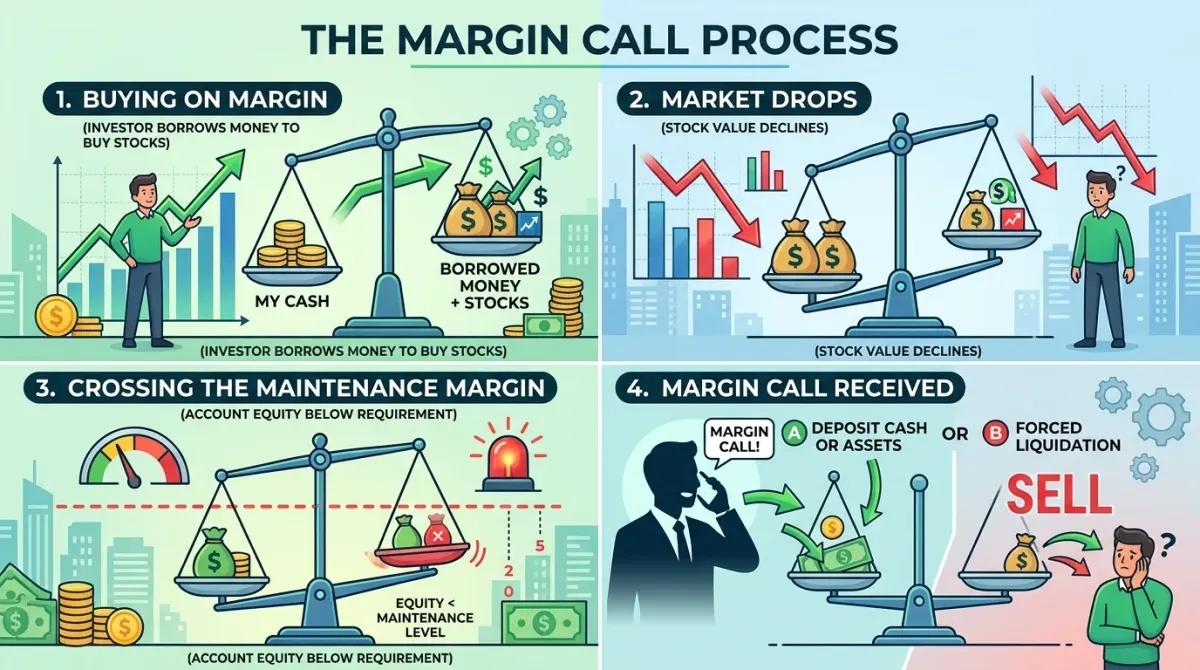
The margin call: a warning signal
The margin call, or margin call, comes into play when your capital becomes insufficient to keep your positions open.
In this situation, your broker sends you an alert to warn you that your margin level is too low.
You then have two options:
Add funds to your account
Close certain positions to reduce your exposure
The margin call is not a penalty, but a protective mechanism. It allows you to react before the situation deteriorates further.
However, in highly volatile market conditions, this warning may come late, or even not leave enough time to act.
Margin close: the ultimate consequence
If no action is taken after a margin call, or if the market moves too quickly against you, the broker may trigger a margin close.
In this case, your positions are closed automatically, without your intervention.
The aim is to prevent your account going negative.
Although it may seem brutal, this mechanism is essential to protect both trader and broker.
The importance of risk management
Margin is not a tool to be used without thought. It must always be part of an overall risk management strategy.
Experienced traders don't seek to use as much leverage as possible. On the contrary, they adapt their exposure according to their risk tolerance and market analysis.
Here are a few essential principles:
Never commit your entire capital to a single position
Use stop-loss orders to limit losses
Keep a sufficient margin of safety
Avoid accumulating too many positions simultaneously
Mismanagement of margin is one of the main causes of loss among novice traders.
The role of the broker
The broker plays a central role in margin trading. It's the broker who provides access to leverage and manages the margin mechanisms.
When you open a position, you don't necessarily own the underlying asset. You speculate on the variation of its price via derivatives.
The broker ensures that your account meets margin requirements at all times. If this is not the case, it automatically intervenes to limit risk.
A more professional view
In a professional approach, margin is not used to "earn faster", but to optimize capital management.
It allows you to fine-tune position size precisely, according to the risk accepted on each trade.
Experienced traders reason in terms of percentage risk per position, not in terms of potential gains.
They use margin as a strategic tool, integrated into an overall system that includes:
market analysis
capital management
emotional discipline
consistency in execution
Most common mistakes
Beginners often make the same mistakes:
Using too much leverage right from the start
Opening positions that are too large
Neglecting risk management
Ignoring margin call signals
Multiplying trades without a clear strategy
These mistakes can lead to a rapid loss of capital.
Tips for using margin wisely
To take advantage of margin without jeopardizing your account, it's important to adopt a disciplined approach:
Start with low leverage
Test your strategies on a demo account
Always anticipate the adverse scenario
Monitor your positions regularly
Maintain sufficient available margin
The aim is not to maximize short-term gains, but to last over time.
Conclusion
Margin is a powerful tool for accessing greater opportunities in the financial markets. Combined with leverage, it offers the possibility of multiplying potential gains with limited capital.
However, this power comes with proportional risk. Losses can be rapid and significant if the market moves in the wrong direction.
Understanding margin therefore means understanding a balance: that between opportunity and risk.
A trader who masters this concept has a real advantage. He can adapt his exposure, manage his capital efficiently and navigate the markets with greater precision and control.
Inversely, ignoring how margin works is tantamount to trading without understanding the rules of the game.
And in the financial markets, this never forgives over the long term.
🎬 Pour aller plus loin
Si tu veux approfondir ce sujet et progresser en trading, retrouve nos vidéos éducatives gratuites sur La Trading School 🎥