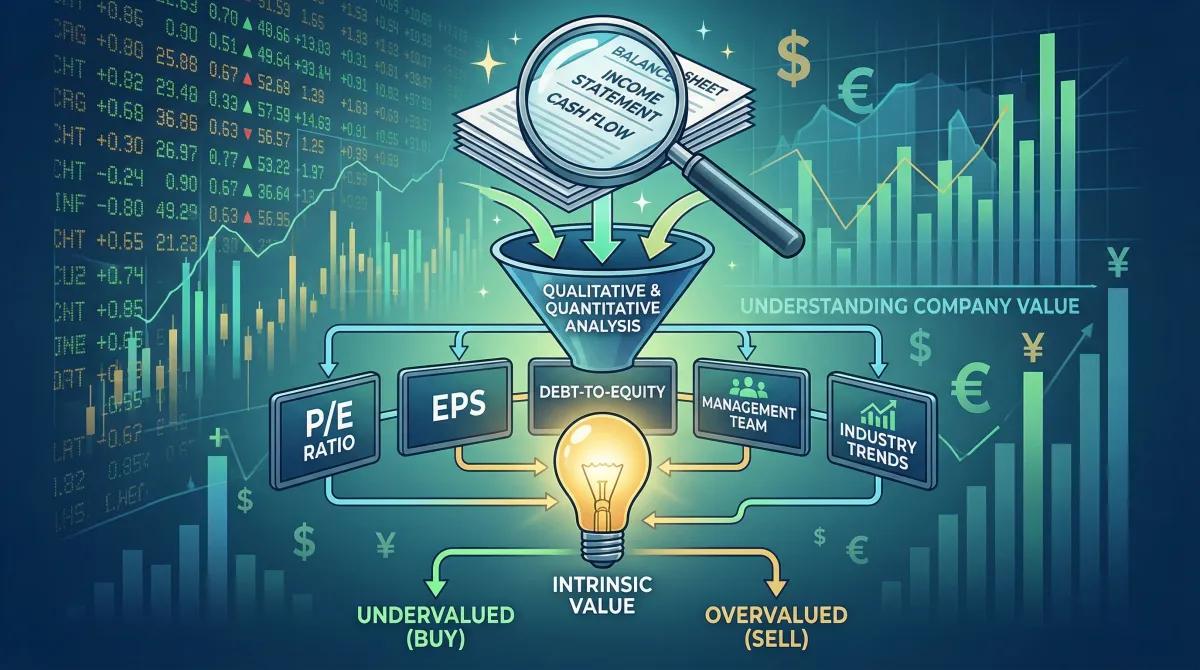
What is fundamental analysis in trading?
Fundamental analysis is an essential approach to trading that involves studying economic, financial and geopolitical factors in order to assess the true value of an asset and anticipate its future evolution.
Unlike simply reading a chart, this method seeks to understand why the market moves, not just how it moves.
A global view of the market
Fundamental analysis is based on a simple idea:
The price of an asset is influenced by supply and demand, which are themselves determined by economic and political factors.
These factors can include:
interest rates
inflation
economic growth
central bank decisions
geopolitical events
consumer behavior
A fundamental trader therefore seeks to understand the global environment in order to anticipate market movements.
Illustration: how the economy influences markets
A major economic change can trigger a major market movement. For example:
A rise in interest rates → attracts investors → stronger currency
An economic crisis → fall in confidence → weaker currency
A natural disaster → impact on production → price rise
Fundamental vs. technical analysis
There are two main approaches in trading:
Technical analysis
Fundamental analysis
Bases itself on economic data and news
Analyzes political and monetary decisions
Anticipates medium/long-term movements
Some traders contrast these two methods, but in reality they can be complementary.
An experienced trader can use:
fundamental to understand overall direction
technical to find the best entry points
Why fundamental analysis is crucial
Trading with charts alone can be risky.
Why?
Because some market movements are triggered by major events impossible to see on a chart before they happen.
Real-life example
When a country announces weak economic data:
investors lose confidence
they sell the currency
the price falls
This type of movement can be sudden and rapid.
A trader who follows the news can anticipate these reactions, unlike one who only looks at the charts.
The major indicators to know
1. GDP (Gross Domestic Product)
GDP measures the wealth produced by a country.
GDP rising → strong economy → strong currency
GDP falling → weak economy → weak currency
This is one of the most closely watched indicators.
2. Inflation (CPI)
Inflation measures the rise in prices.
Moderate inflation → healthy growth
High inflation → loss of purchasing power
Too high inflation often prompts central banks to raise interest rates.
3. Interest rates
This is probably the most important factor in trading.
High rates → attract investors → currency rises
Low rates → less attractive → currency falls
Central bank decisions can provoke violent market movements.
4. Employment (NFP)
Employment data reflect economic health:
More jobs → strong consumption → buoyant economy
Less jobs → economic slowdown
These announcements can create high volatility.
5. Trade balance
Measures the difference between exports and imports:
Surplus → strong demand for currency
Deficit → downward pressure
Supply and demand: the heart of the market
All market movements rest on one thing:
the balance between supply and demand
Examples:
Less oil available → price rises
High demand for a currency → value rises
Fundamental analysis seeks to understand these imbalances before they appear on the charts.
The two approaches in fundamental analysis
Top-Down approach
You start from the global to the specific :
Analysis of the global economy
Analysis of a country
Analysis of an asset
Bottom-Up (bottom-up)
You start from the asset itself:
Analysis of the asset
Analysis of its sector
Analysis of the economic environment
How to use fundamental analysis in trading
To integrate this approach, a trader must:
follow the economic calendar
analyze major announcements
understand the impact of political decisions
anticipate market reactions
The aim is not to react to the news, but to understand :
how the market will interpret this information
Concrete example of reasoning
Let's imagine:
Rising inflation
Central bank likely to raise rates
Probable consequence:
Rising rates → more attractive currency → rising currency
A fundamental trader can then anticipate a bullish trend.
The limits of fundamental analysis
Although powerful, this approach has its limits:
markets can react irrationally
good news may already be "priced in"
reactions can be unpredictable in the short term
That's why many traders combine fundamental and technical.
Frequent beginner mistakes
Ignoring economic news
Trading during announcements without understanding their impact
Confusing good news with market reaction
Failing to anticipate volatility
A more professional view
Experienced traders don't try to predict every move.
They seek to understand:
Macroeconomic trends
Capital flows
Market sentiment
They use fundamental analysis to build an overall picture, then refine with other tools.
Conclusion
Fundamental analysis is a method for gaining an in-depth understanding of the forces that influence financial markets.
It's not just about numbers, but encompasses economics, politics, investor psychology and world events.
Mastering this approach enables you to:
better anticipate major trends
avoid unforeseen movements
make more informed decisions
This is a key skill for any trader wishing to move from an intuitive to a truly strategic approach.
For more: https://www.youtube.com/watch?v=isKSkzvd1CM&t=322s
🎬 Pour aller plus loin
Si tu veux approfondir ce sujet et progresser en trading, retrouve nos vidéos éducatives gratuites sur La Trading School 🎥