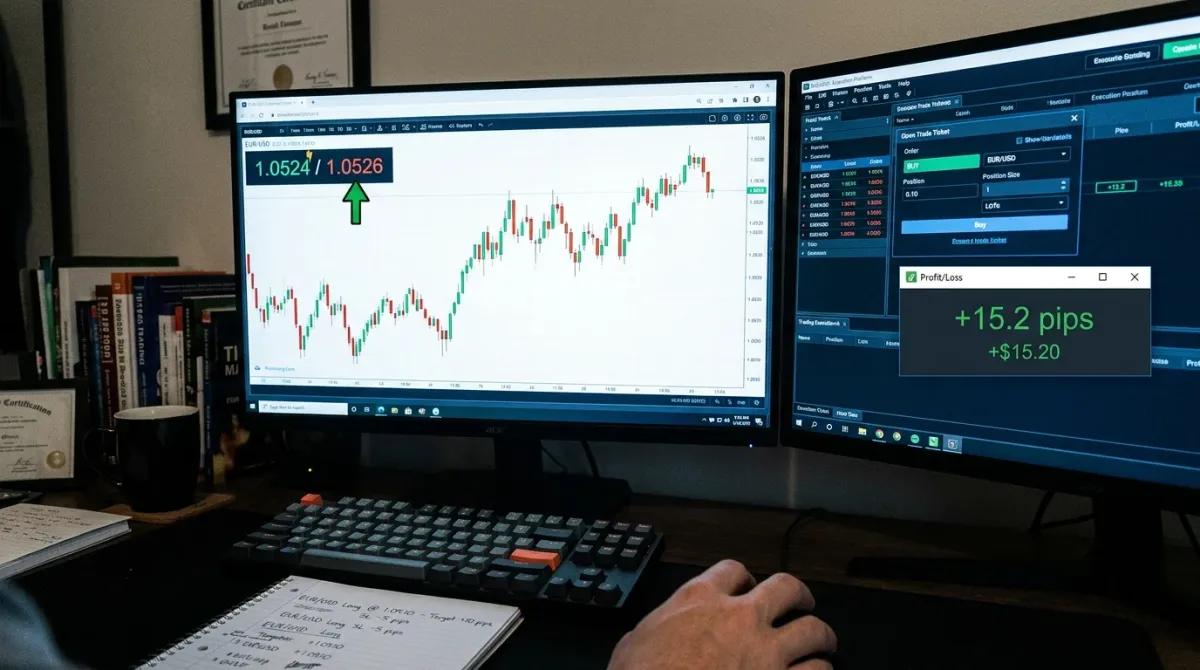
What is a pip in trading?
In the world of trading, and the forex market in particular, the term "pip" is ubiquitous. Yet many beginners struggle to understand what it actually represents and why it's so important.
In reality, the pip is one of the most fundamental units in trading. It allows us to measure price variations, calculate gains and losses, and accurately assess the evolution of a market.
Understanding what a pip is is therefore an essential step for any trader wishing to progress.
Simple definition of a pip
The word "pip" stands for "percentage in point". It is the smallest standardized variation in the price of an asset, particularly in the currency market.
In other words, the pip is a unit of measurement that quantifies price movements.
Rather than saying that a market has moved by 0.0005 or 0.0050, traders use pips to simplify reading. This makes variations more legible and comparable.
Why are pips important?
Pips play a central role in trading for several reasons:
They enable precise measurement of market movements
They are used to calculate gains and losses
They help define profit targets and risk levels
They facilitate communication between traders
In practice, a trader almost never talks in euros or dollars, but in pips. It's a universal way of expressing the performance of a trade.
How does a pip work?
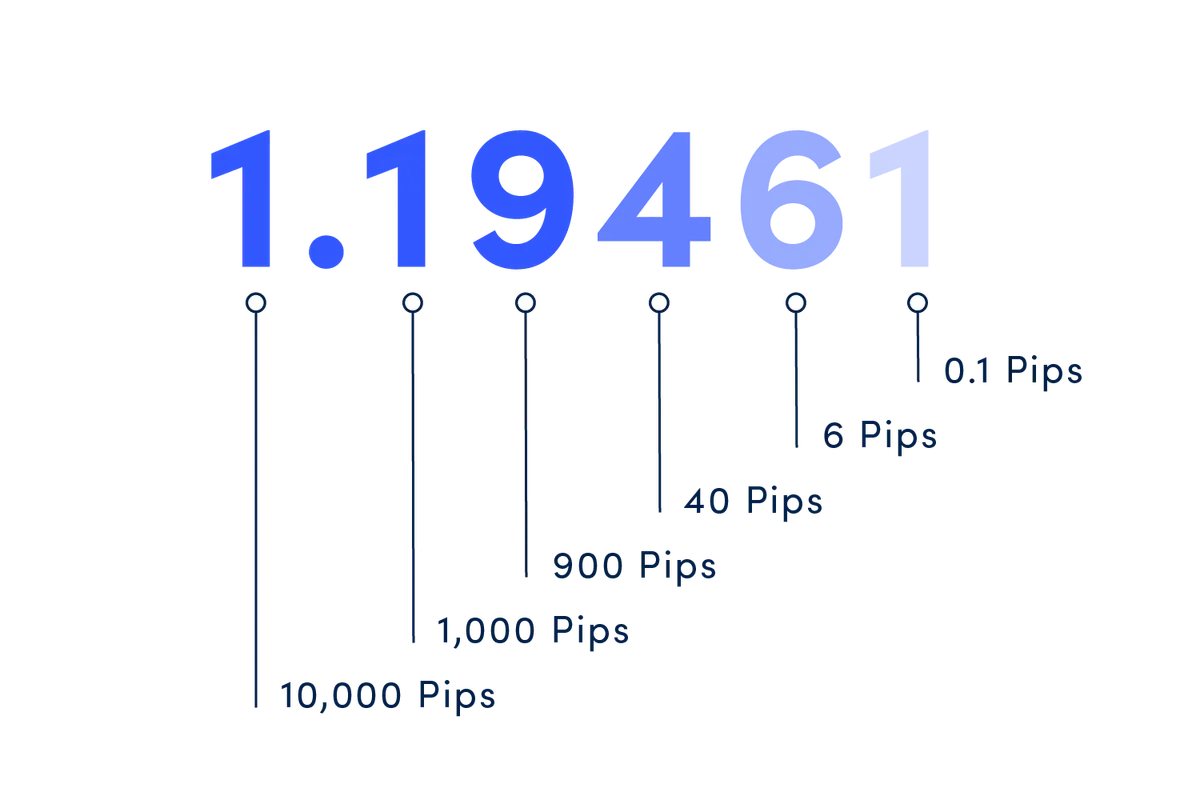
Every price movement can be translated into pips.
If the market moves in your direction → you gain pips
If it moves against you → you lose pips
The higher the number of pips, the greater the movement.
However, it's essential to understand that the pip does not directly represent a sum of money. Its value depends on the size of your position.
Pips on the forex market
On forex, the majority of currency pairs are quoted with four decimal places.
In this case, one pip corresponds to the fourth digit after the decimal point.
Example:
If the EUR/USD pair moves from:
1.1000 to 1.1001 → movement of 1 pip
1.1000 to 1.1010 → movement of 10 pips
1.1000 to 1.1050 → movement of 50 pips
This means that each change of 0.0001 corresponds to one pip.
The special case of the Japanese yen
Some currency pairs, particularly those involving the Japanese yen (JPY), work differently.
They are usually quoted with two decimal places instead of four.
In this case, one pip corresponds to the second digit after the decimal point.
Example:
If USD/JPY goes from:
150.00 to 150.01 → 1 pip
150.00 to 150.50 → 50 pips
This is simply explained by the structure of quotations on these pairs.
Concrete examples of pips gains and losses
To fully understand the impact of pips, it's useful to see how they translate into real trading.
Example 1: winning trade
You buy EUR/USD at 1.1000
The price rises to 1.1050
→ You gain 50 pips
Example 2: losing trade
You buy EUR/USD at 1.1000
The price falls to 1.0950
→ You lose 50 pips
In both cases, the number of pips simply measures the distance traveled by the price.
The link between pips and money
A key point to understand is that pips don't directly represent money.
The gain or loss depends on the size of your position.
For example:
With a small position → 50 pips = small gain
With a large position → 50 pips = much larger gain
This is where leverage comes into play. By increasing the size of your position, it amplifies the monetary value of each pip.
Pips in other markets
Although the pip is mainly used in forex, the principle also exists in other markets such as:
commodities (gold, oil)
stock market indices
certain cryptocurrencies
However, the pip position can vary depending on the asset.
For example:
On gold, a pip often corresponds to 0.01
On certain indices, it may correspond to another unit
The principle remains the same: to measure price variations.
What is a pipette?
As trading platforms have evolved, an additional precision has been introduced: the pipette.
A pipette corresponds to one tenth of a pip.
This means that some pairs are now quoted with an extra decimal place.
Example:
EUR/USD can be displayed as:
1.10005
Here:
1 pip = 0.0001
1 pipette = 0.00001
This precision enables finer analysis of market movements.
Why traders use pips
Pips offer several advantages:
A standardized unit used throughout the world
Better legibility of price movements
Simplified performance calculations
Independence on position size
They enable reasoning in terms of pure performance, unaffected by committed capital.
The importance of pips in risk management
Pips are essential for managing risk.
When you open a trade, you should always define:
your target gain (take profit)
your maximum loss level (stop loss)
These levels are expressed in pips.
For example:
objective: +50 pips
risk: -20 pips
This helps to structure your trade and keep a disciplined approach.
Frequent beginner mistakes
Many beginners make mistakes related to pips:
Failing to understand their true value
Focusing solely on cash gains
Unaware of the link between pips and position size
Failing to use pips to manage risk
These mistakes can lead to poor capital management.
A more professional view
Experienced traders reason almost exclusively in pips.
Why?
Because it allows them to:
comparison their performance objectively
standardize their strategies
remain consistent in their risk management
A professional trader won't say "I made €500" but rather "I made 50 pips".
Conclusion
The pip is a fundamental unit in trading that measures price variations on the markets, particularly forex.
It's used to calculate gains and losses, analyze market movements and structure trading strategies.
Although it may seem technical at first, the pip is actually a simple and indispensable tool. Once mastered, it provides a much clearer and more professional reading of the markets.
Understanding pips is the first step towards a more rigorous approach to trading, based on precision, discipline and risk management.
🎬 Pour aller plus loin
Si tu veux approfondir ce sujet et progresser en trading, retrouve nos vidéos éducatives gratuites sur La Trading School 🎥