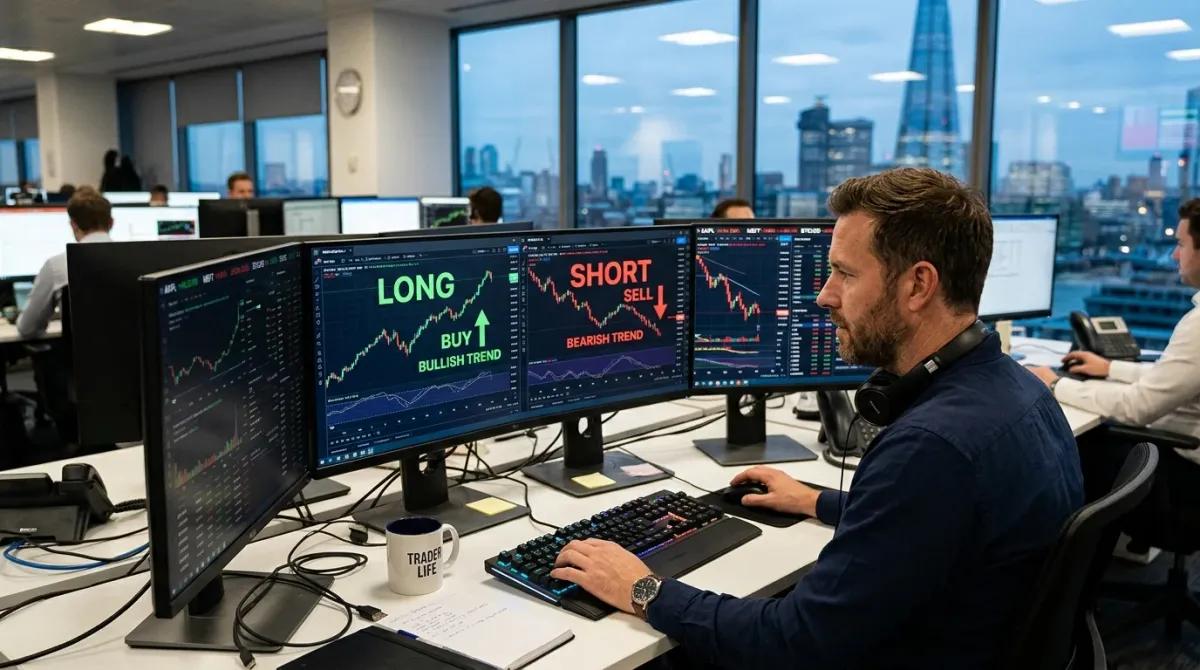
What does it mean to be "long" or "short" in trading?
In trading, there are two main ways of trying to make money depending on the direction of the market. You can either bet that the price will go up, or bet that it will go down. These two approaches are called "going long" and "going short" respectively. Although these words may seem complicated at first, their logic is actually quite intuitive once explained with simple, concrete examples.
Understand the basic idea with an everyday situation
Imagine you're buying something in a store today. You think that in a few days, this object will become rarer and therefore more expensive. If your hunch is right, you'll be able to resell it later at a higher price and make a profit.
That's exactly the idea behind a "long" position. You buy now in the hope of reselling for more later.
Now imagine the opposite. You think that the price of an item is currently too high and that it will soon drop. In this case, you can try to profit from this drop by selling first, then buying back later at a lower price.
This is called a "short" position.
🟢The "long" position explained simply
To be "long" means that you buy a financial asset in the belief that its price will rise.
In practice, it works like this:
You enter the market by buying an asset at a certain price. Then you wait for the market to move in your favor. If the price rises, you can resell at a higher price and make a profit.
Concrete example
Imagine you buy a stock at €50.
A few days later, its price rises to €65.
You decide to sell.
In this case, your gain is the difference between your buying price and your selling price.
👉 You bought low and sold high.
🔴The "short" position explained simply
To be "short" is to do the opposite. You sell an asset in anticipation that its price will fall.
This may seem strange at first, mainly because you can sell something you don't yet own. In reality, the broker sets up a mechanism that allows you to borrow this asset temporarily.
Then, when the price falls, you buy back this asset at a lower price to give it back.
Concrete example
You "sell" a position at €100.
The price then drops to €70.
You buy back at this new price.
👉 You've sold high and bought back low.
An anecdote to better understand shorts
To make this more concrete, imagine a fruit market.
A seller thinks that the price of apples is too high today and will fall tomorrow because supply will increase.
So he decides to sell his apples today at a high price, then buy them back tomorrow at a lower price to return them to his supplier.
Even if the trading mechanisms are more technical, the idea remains the same: to profit from a fall in prices.
Why does trading allow you to go long or short?
In the past, investors had to own an asset in order to sell it. This limited the strategies possible, as money could only be made when markets were rising.
With the evolution of financial markets and the advent of derivatives, it became possible to speculate on price movements without actually owning the asset.
This has enabled traders to:
profit from rises
but also from falls
and therefore have more opportunities on the markets
Fundamental difference between long and short
Here's a simple way of looking at it:
When you're long, you make money if the price goes up.
When you're short, you make money if the price goes down.
In both cases, your objective is always the same: buy lower and sell higher. The difference simply lies in the order of operations.
Comparative example
Let's take the same asset at two different times.
Long case
You buy at 200
The price rises to 240
You sell
👉 You earn 40
Short case short
You sell at 200
The price drops to 160
You buy back
👉 You earn 40
In both cases, profit depends on the difference between two prices, but the logic of market entry is reversed.
Another way of looking at it
It can also be simplified like this:
To be long is to bet on a market's growth.
To be short is to bet on its decline.
Experienced traders often use both approaches depending on the economic context, trends and technical or fundamental analysis.
Why shorts are often harder to understand
Shorts are less intuitive because they go against our natural logic.
We're used to buying a product first and then selling it. In shorts, this order is reversed.
This is why many beginners find this notion confusing at first, even though it becomes logical with practice.
An interesting historical anecdote
In traditional markets, such as commodities, traders had to physically store the products they bought, like wheat or coffee.
Over time, financial markets evolved to allow traders to speculate without physically storing the assets.
This evolution made modern trading possible as we know it today, where long and short positions are used daily on electronic platforms.
The role of brokers in short
When you take a short position, you don't need to own the asset. The broker acts as an intermediary.
It allows you to open a sell position, then close it later by automatically buying back the difference.
In practice, you're not directly manipulating the actual asset. You're simply trading the change in its price.
Why traders use long and short positions
Financial markets don't always follow a single direction. They alternate between rising, falling and consolidating phases.
Thanks to long and short positions, traders can:
adapt to all market conditions
multiply opportunities
avoid remaining passive when the market falls
This makes it possible to be active even in difficult economic times.
Frequent beginner mistakes
Many beginners think trading is all about buying and waiting for the price to rise. They often ignore the potential of shorts.
Another common mistake is to mismanage risk, whether in a long or short position. Being right about the direction of the market is not enough if capital management is poor.
Clear summary
To be long means to buy an asset in anticipation of a rising price.
To be short means to sell an asset in anticipation of a falling price.
In both cases, profit depends on the difference between the entry price and the exit price. The main difference lies in the direction of the market you're betting on.
Understanding the difference between long and short is an essential foundation in trading. It makes it easier to analyze markets and build strategies suited to different situations.
A trader who masters these two notions has greater flexibility and can react effectively to market movements, whether bullish or bearish.
With time and experience, the combined use of long and short becomes a real advantage when navigating the trading world.
to go further: https://www.youtube.com/@Latradingschool
🎬 Pour aller plus loin
Si tu veux approfondir ce sujet et progresser en trading, retrouve nos vidéos éducatives gratuites sur La Trading School 🎥