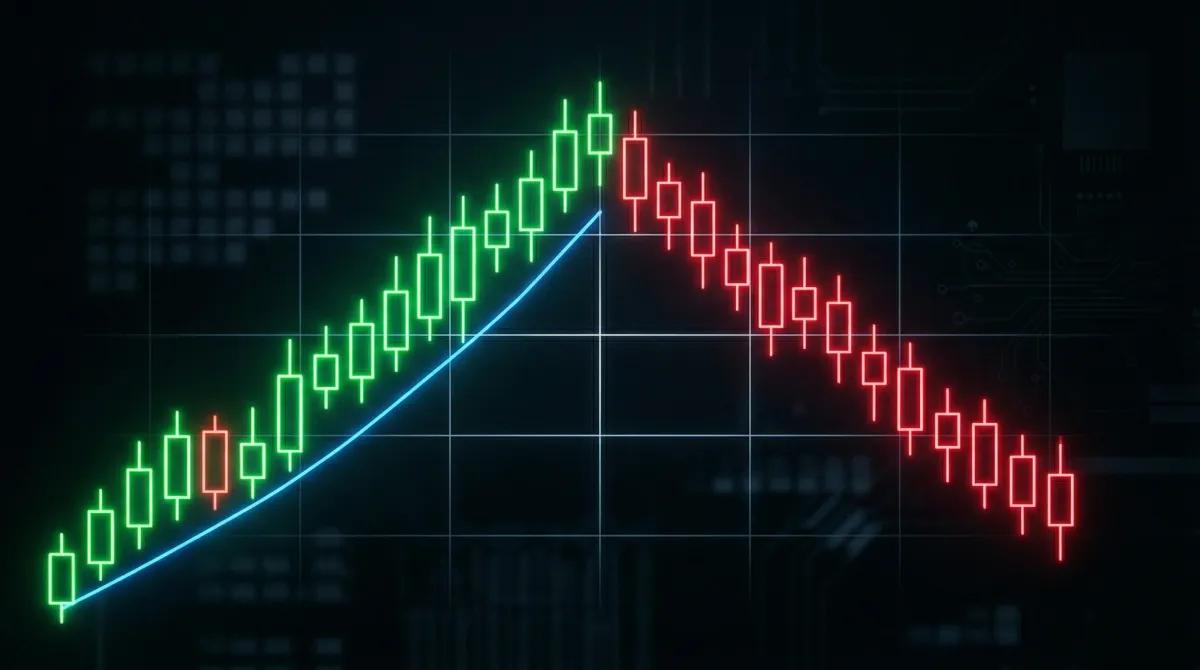
Market structure is one of the most fundamental concepts in trading, but also one of the most underestimated by beginners. It enables us to read a chart not as a sequence of random movements, but as a logical organization of price behavior.
Understanding market structure comes down to understanding how price builds up over time, why it moves in a given direction, and above all how to anticipate changes in direction with greater precision.
What is market structure?
Market structure describes the organization of price movements through successive peaks and troughs. By observing these points, we can determine whether the market is in an uptrend, downtrend or consolidation phase.
There are three main phases:
Uptrend
Downtrend
Range market (sideways)
In an uptrend, the price forms higher and higher peaks as well as higher and higher troughs. Conversely, in a downtrend, peaks and troughs are lower and lower.
When the market shows no clear direction, it moves into a range zone, where the price oscillates between support and resistance.
Swing highs and swing lows
To analyze structure, it's essential to identify swing highs (local peaks) and swing lows (local troughs).
A swing high corresponds to a point where the price peaks before falling back down. A swing low is the opposite: a low point before a rebound.
These points make it possible to visually trace the structure of the market and identify areas where buyers and sellers are taking control.
By observing the succession of these points, we can determine whether buyers are dominating the market or whether sellers are taking over.
Trends and how to read them
An uptrend is characterized by a series of ascending higher highs and higher lows. This means that each bullish impulse pushes the price beyond the previous high, while corrections do not break previous lows.
In a bearish trend, we observe lower highs and lower lows. The market creates new lower lows, and each rebound fails to break through the previous highs.
Identifying a trend correctly avoids trading against the grain and significantly increases the probability of success.
The concept of structure change
One of the most important elements in market structure is structure change. It indicates a possible reversal or transition between two market phases.
For example, in an uptrend, if the price breaks a previous low (break of structure), this may signal a weakening of the buyers and a possible start of a reversal.
Inversely, in a downtrend, the break of a previous high may indicate that sellers are losing control.
These breaks should not be interpreted in isolation. They take on their full meaning when analyzed in the overall context of the market.
Break of Structure (BOS) and Change of Character (CHoCH)
Two key notions provide a better understanding of market transitions:
The Break of Structure (BOS) corresponds to a continuation of the trend. For example, in an uptrend, a BOS occurs when the price breaks a previous high.
Change of Character (CHoCH), on the other hand, signals a possible change in trend. It generally appears when the price breaks a structure opposite to the current trend.
For example, after a series of higher highs and higher lows, if the price breaks a significant low, this may indicate that the uptrend is running out of steam.
These concepts are particularly used in modern approaches such as institutional trading and the Smart Money Concept.
The importance of market phases
The market doesn't move in a straight line. It constantly alternates between impulse phases and correction phases.
An impulse corresponds to a strong movement in a given direction, while a correction is a temporary opposite movement.
Understanding this alternation helps to avoid confusing a simple correction with a trend reversal.
For example, in an uptrend, a retracement can give the impression that the market is turning bearish, when it's really just a pause before a new impulse.
Why market structure is essential
Market structure forms the basis of any serious technical analysis. It enables :
Identify the dominant trend
Anticipate potential reversal zones
Understand the behavior of buyers and sellers
Avoid trading against the market
Improve timing of entries
Without understanding structure, trading decisions often rely on isolated signals or delayed indicators, increasing the risk of error.
Common beginner mistakes
Many beginner traders focus solely on technical indicators without considering the overall market structure.
Another common mistake is trying to anticipate a reversal without confirmation. The market can remain in a trend much longer than expected.
Finally, some traders misidentify swing highs and swing lows, which completely distorts their reading of the market.
Conclusion
Market structure is one of the most important pillars of trading. It enables one to understand price behavior logically and anticipate movements more accurately.
By learning to identify trends, swings and changes in structure, a trader can gradually develop a more professional view of the market.
Mastering this concept does not guarantee success, but provides an indispensable foundation for building a coherent and sustainable strategy.
🎬 Pour aller plus loin
Si tu veux approfondir ce sujet et progresser en trading, retrouve nos vidéos éducatives gratuites sur La Trading School 🎥