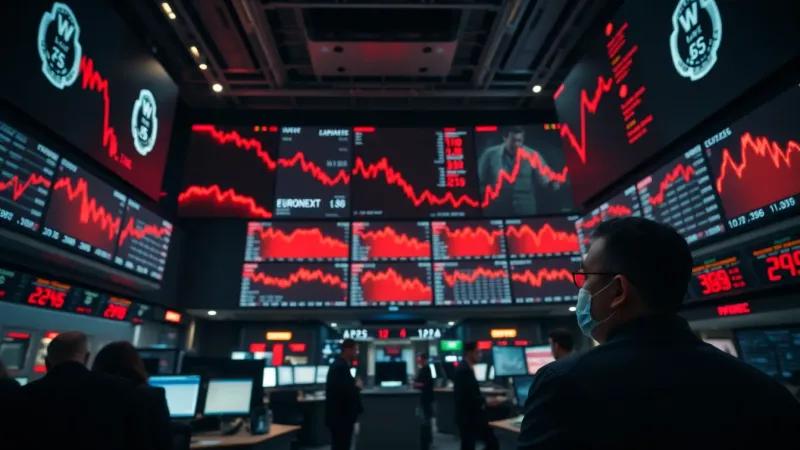
Major European stock markets are set to open lower on Tuesday, with the CAC 40 expected to fall 0.81%, the DAX 0.73%, and the Stoxx 600 0.7%. The reason? Donald Trump dropped a bombshell on Monday by declaring that the temporary ceasefire with Iran, announced nearly five weeks ago, was on life support. Unprecedented. 📉
🔍 What’s going on?
The U.S. president doesn’t mince words. His shocking metaphor clearly signals that disruptions to shipping traffic in the Strait of Hormuz will continue, and with them, soaring energy prices. Brent crude remains above $100 a barrel, a situation that is particularly worrying for a Europe dependent on energy imports.
Weekend negotiations failed to yield any concrete progress. Trump is set to travel to Beijing on Wednesday to meet with Xi Jinping and pressure China to use its influence on Tehran. But analysts remain skeptical about the chances of significant progress, whether on the Iranian issue or trade.
💡 Why does this matter?
For Europe, it’s a double blow. First, the direct impact on energy prices. Suvro Sarkar, head of the energy sector at DBS Bank, made it clear: if no agreement is reached by the end of May, further increases in oil prices are likely. The Stoxx 600 index is already about 4% below its pre-crisis levels.
Second, the inflationary effect. Germany confirmed inflation at 2.9% in April. Markets now anticipate two rate hikes in Europe by September, with a 75% probability of a third by year-end. This situation stands in stark contrast to the United States, where the Fed is expected to keep rates unchanged for some time. U.S. inflation figures for April are due out this Tuesday and are expected to confirm a sustained rise for the second consecutive month.
📊 Our view
In our view, the European market is caught in a vise. Indices are technically fragile, and the fundamental context does not point to a quick rebound.
Europe is bearing the brunt of geopolitical instability in the Middle East without any leverage to act. Unlike the United States, which is negotiating directly with Iran, or China, which wields diplomatic influence over Tehran, the European Union remains a bystander. As a result, it is bearing the brunt of energy price volatility and seeing inflation rise again, forcing the ECB to tighten monetary policy even as European growth remains sluggish. The monetary policy divergence with the Fed risks widening, which will weigh on the euro. Currently, the EUR/USD is trading at 1.1770, a level that could be challenged if the Fed-ECB divergence is confirmed. Meanwhile, energy sector stocks remain the sole beneficiaries of this instability, but watch out for rapid profit-taking in the event of a sudden reversal in negotiations.
We anticipate high volatility in the coming weeks, with a bearish bias on European indices as long as no clear agreement emerges on the Iran issue. For French traders: favor short positions on European indices with a tight stop, and closely monitor the CAC 40’s support levels.
✅ Key Takeaway
- Trump says the ceasefire with Iran is on life support
- European stock markets are expected to open down 0.7% to 0.8%
- Brent remains above $100 per barrel
- Markets expect two ECB rate hikes by September
- The Stoxx 600 index remains 4% below its pre-crisis levels
What do you think? Do you still believe in a rebound for European indices, or do you anticipate a deeper correction?
🔎 See also
For more in-depth analysis, check out all our economic insights on ActuTrading Economy 📈
Source: Reuters, statements by Donald Trump, DBS Bank