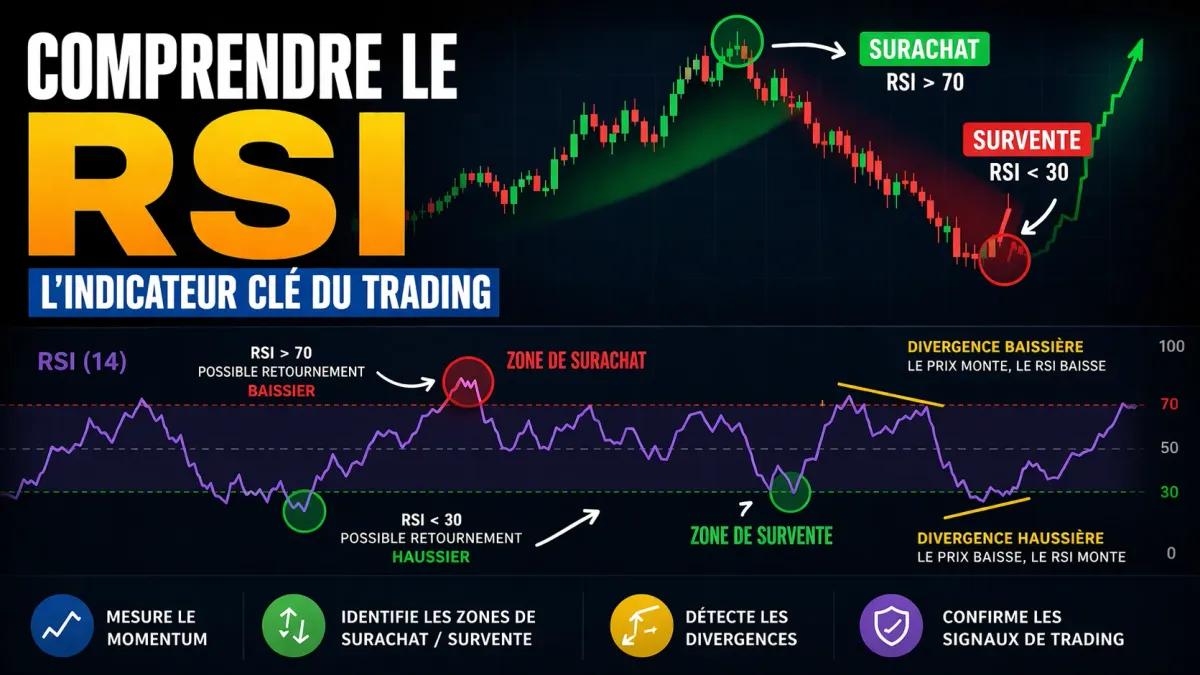
Among all the technical indicators available, the RSI (Relative Strength Index) is one of the most popular among beginner... and experienced traders.
Simple to understand on the surface, it's often misused, leading to avoidable losses.
👉 In this article, you'll learn:
what the RSI really is
how it works
how to use it intelligently
and above all how to avoid classic mistakes
What is the RSI (Relative Strength Index)?
The RSI is a momentum indicator that measures the speed and amplitude of price movements.
It moves on a scale of 0 to 100 and identifies two key zones:
above 70 → overbought
below 30 → oversold
👉 The basic idea:
When an asset is "overbought", it could correct.
When it's "oversold", it could rebound.
How the RSI actually works
The RSI compares the average gains and losses over a given period (usually 14 periods).
It does not predict the market, but gives an indication of:
the strength of a trend
the potential running out of steam of a movement
👉 Important:
A high RSI does not necessarily mean that the market will fall immediately.
Why the RSI often gives false signals
This is the number 1 mistake beginners make.
They think:
RSI > 70 = sell
RSI > 30 = buy
❌ This is wrong in many cases.
In a strong trend:
the RSI can stay above 70 for a long time
or below 30
👉 Result: entering against the trend = repeated losses.
How to use the RSI intelligently
The RSI becomes powerful when used with context.
1. Trade in the direction of the trend
in uptrends → favor buying in oversold zones
in downtrends → favor selling in overbought zones
👉 Never use the RSI alone against the market.
2. Use RSI divergences
Divergences are one of the most reliable signals.
Bullish divergence:
price falls
the RSI rises
→ potential upward reversal signal
Bearish divergence:
price rises
RSI falls
→ potential downside signal
👉 Divergences show weakening momentum.
3. Adjust levels according to the market
30/70 levels are not universal.
In certain conditions:
bullish market → 40 / 80
bearish market → 20 / 60
👉 Adjusting the RSI improves its accuracy.
Errors to avoid with the RSI
Here are the most common pitfalls:
using the RSI alone
trading each signal without a filter
ignoring the overall trend
entering too early without confirmation
👉 The RSI is a tool, not a complete strategy.
RSI vs other indicators: why it remains popular
The RSI is popular because it:
is simple to understand
works across all markets (forex, crypto, equities)
helps visualize momentum quickly
But compared to other indicators:
it's less reliable in strong trends
it requires proper interpretation
👉 Its strength depends entirely on how it's used.
Conclusion
The RSI is an excellent indicator... as long as you know how to use it correctly.
Remember this:
it should never be used alone
it works best with the trend
divergences are its most powerful signals
👉 Mastering the RSI is already passing an important milestone in trading.
To go further, here's a youtube video: click here
🎬 Pour aller plus loin
Si tu veux approfondir ce sujet et progresser en trading, retrouve nos vidéos éducatives gratuites sur La Trading School 🎥