Market psychology: what's really going on in traders' heads
When you're new to trading, you often think it's all about indicators, patterns or strategies. In reality, market movements are largely influenced by human behavior. Every price movement reflects decisions made by thousands of traders, often driven by emotion rather than pure logic. Understanding this allows us to better interpret market movements and avoid trading "blind".
The market is dominated by emotions
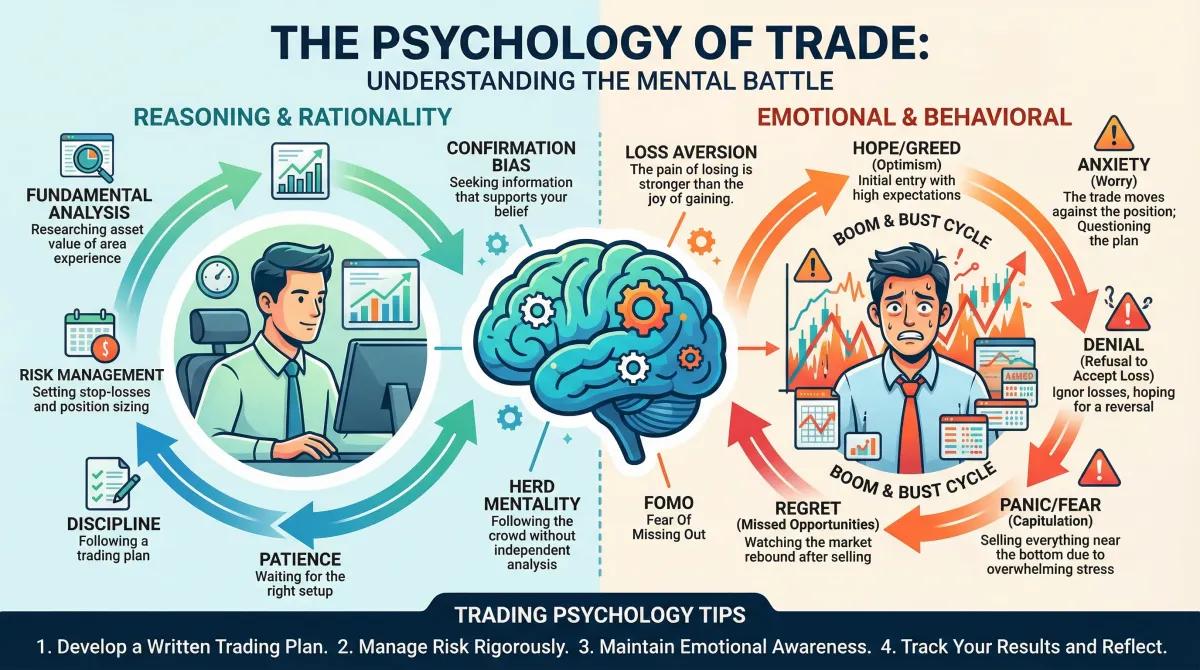
Markets are not totally rational. They are influenced by emotions like fear, hope and excitement. When the price rises rapidly, many traders feel euphoria and want to get in without delay. Conversely, when the market falls, fear drives people to sell too soon or to panic. These collective reactions create the trends and reversals we see on the charts.
The FOMO trap among beginners
FOMO (Fear Of Missing Out) is one of the most common behaviors among novice traders. It occurs when a trader enters a market simply because he or she has already moved around a lot. For fear of missing an opportunity, they act without waiting for confirmation. The problem is that these late entries are often made at the wrong time, just before a correction. Learning to wait for clean setups is essential to avoid this trap.
Buy too early or sell too late
Another common behavior is to act at the wrong time. Some traders buy after a sharp rise, thinking the move will continue, when the market is already overbought. Others sell in panic after a fall, when the price is close to support. These decisions are often driven by emotions rather than structured analysis.
Fear of losing and fear of missing out
Two opposing emotions strongly influence decisions: fear of losing money and fear of missing an opportunity. The former leads to closing a winning position too soon, or avoiding taking a trade. The second pushes you to enter too quickly without waiting for confirmation. Finding a balance between these two emotions is a major challenge for any trader.
The need to "make up" after a loss
After a losing trade, many beginners immediately seek to recoup their loss. This leads to impulsive decisions, often outside any strategy. This behavior increases risk and can lead to consecutive losses. Trading should remain a methodical activity, not a short-term emotional reaction.
The role of discipline in success
Discipline is what allows you to control your emotions. A disciplined trader follows a pre-defined plan, respects his entry and exit rules, and accepts losses as a normal part of the process. Without discipline, even a good strategy can become ineffective, as decisions will be influenced by emotions.
How emotions influence market movements
Traders' emotions are not isolated, they add up. When many participants act in similar ways, it creates powerful movements. For example, a rapid rise attracts buyers through FOMO, further accelerating the rise. Conversely, a fall can trigger chain-selling, amplifying the decline. The market therefore moves largely thanks to these collective reactions.
The notion of liquidity and mass behavior
The areas where traders place their stop-losses become important zones of liquidity. When the price reaches these levels, it triggers cascading orders, causing rapid movements. This can give the impression that the market is "chasing" traders, when in fact it's simply reacting to the concentration of orders at these levels.
The importance of the mind in progressing in trading
Two traders can use the same strategy but achieve different results because of their minds. The one who controls his emotions, sticks to his plan and remains patient will tend to be more consistent. Conversely, a trader influenced by his emotions will often change decisions, enter too early or exit too late, negatively impacting his performance.
Conclusion
Market psychology is a fundamental element for any novice trader to understand. Emotions such as fear, greed and FOMO directly influence decisions and create the movements visible on charts. Learning to recognize these behaviors, both one's own and those of others, enables you to step back and improve your decision-making in an environment where discipline is more important than intuition.
🎬 Pour aller plus loin
Si tu veux approfondir ce sujet et progresser en trading, retrouve nos vidéos éducatives gratuites sur La Trading School 🎥