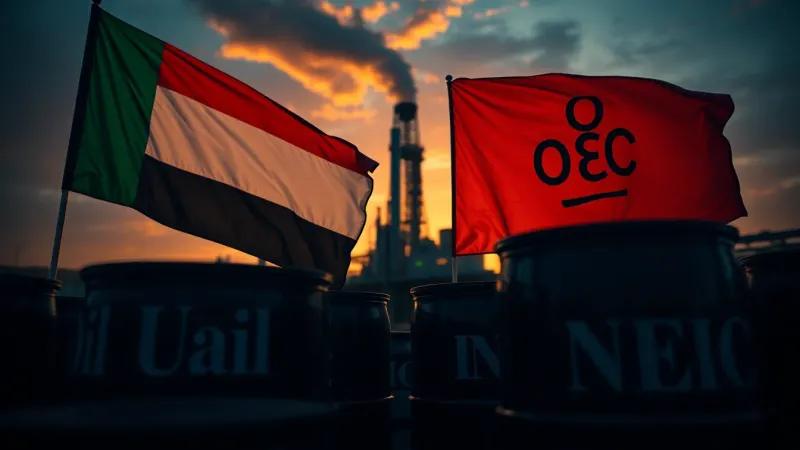
The United Arab Emirates has just announced its withdrawal from OPEC in the national interest. This surprise departure weakens the alliance of oil-producing nations and deals a blow to Riyadh. For Washington, it is a major diplomatic victory. 🛢️
🔍 What’s happening?
Abu Dhabi has decided to leave the Organization of the Petroleum Exporting Countries without warning. The decision comes amid a tense geopolitical situation in the Middle East, with a war already destabilizing the region.
The United Arab Emirates is OPEC’s third-largest producer behind Saudi Arabia and Iraq. Its departure automatically weakens the organization’s ability to control crude oil prices and coordinate production quotas among members.
💡 Why does this matter?
This withdrawal is reshaping the balance of the global oil market. OPEC is losing a heavyweight capable of producing more than 3 million barrels per day. The UAE will now be able to increase its production without negotiating with Riyadh.
For the United States, this is a major diplomatic coup. Washington has been pushing for years to break Saudi Arabia’s influence over oil prices. With this departure, the OPEC+ alliance finds itself weakened at a time when Russia is also seeking to free itself from the quotas imposed by the Saudis.
For traders in WTI and Brent, this means more volatility in the short term. The UAE could flood the market to gain market share, which would put downward pressure on prices. But if OPEC retaliates by cutting its own production, we could see the opposite effect.
📊 Our take
This is a major strategic shift. The UAE is choosing its side, and it is no longer Riyadh’s.
We see three direct consequences. First, OPEC loses its power to unilaterally set crude oil prices. Second, Saudi Arabia finds itself isolated against an informal coalition of the United States and the UAE that can drive prices down if necessary. Finally, Russia could follow suit and also leave OPEC+ to maximize its oil revenues and finance its war effort. For Europe and France, this is an opportunity to diversify supplies and reduce dependence on Riyadh’s decisions. The European Commission could accelerate negotiations with Abu Dhabi to secure long-term contracts at competitive prices.
We expect downward pressure on Brent over the next 3 to 6 months, barring a drastic Saudi countermeasure. For French traders: monitor UAE production announcements and OPEC+ meetings in the coming weeks before taking a position on crude oil.
✅ Key Takeaway
- The United Arab Emirates is leaving OPEC without notice in the name of national interest
- This departure weakens Saudi Arabia and the OPEC+ alliance in the oil market
- Washington scores a major diplomatic victory over Riyadh
- The UAE will now be able to produce without the production quotas imposed by OPEC
- Volatility in WTI and Brent is expected to increase in the short term
What do you think? Will the UAE really flood the market, or will they negotiate behind the scenes with Riyadh to avoid a price war?
🔎 See also
For more in-depth analysis, check out all our Commodities reports on ActuTrading Commodities 📈
Source: France 24