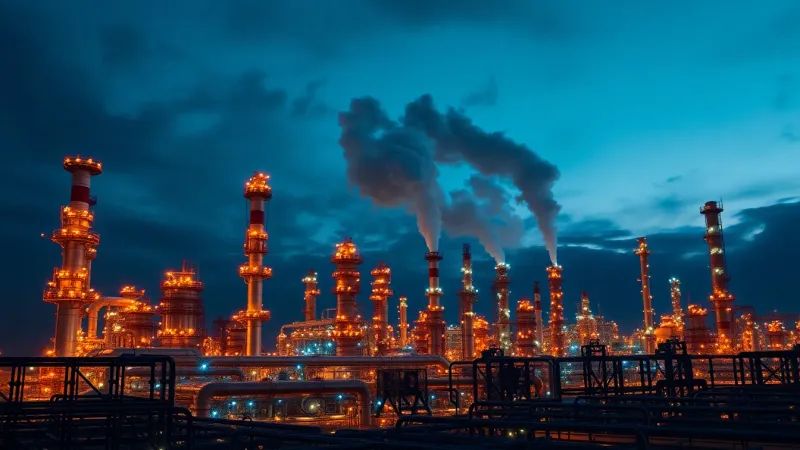
On March 12, retail investors poured $211 million into oil ETFs in a single day. An all-time record. For context: that's more than during the May 2020 crash, when the world discovered negative prices. This statistic should have gone unnoticed. Instead, it should make your blood run cold. For it reveals an uncomfortable truth: the oil market, once the preserve of sophisticated institutional investors, is becoming a playground for inexperienced traders doped up on geopolitical adrenaline.
What's happening
According to Vanda Research, net retail buying flow into oil ETFs peaked at $211 million on March 12, smashing the previous record dating back to the April-May 2020 crash. The catalyst? War volatility. Geopolitical tensions, supply shocks, OPEC+ decisions, fears of flow disruption: so many variables that create dizzying, exhilarating, hypnotizing movements for the retail trader.
This influx of volatility is the result of a number of factors.
This influx of capital brings with it a new dynamic: oil becomes a meme. WTI and Brent are no longer fundamental commodities linked to the fundamentals of the global economy. They're becoming leveraged lottery tickets. And like any financial meme, volatility is self-fueling.
Why it matters to traders
Primo, this concentration of retail money creates a structural price distortion detached from fundamentals. When 211 million euros of small traders massively enter long positions in oil ETFs, they're not performing a rigorous supply/demand analysis: they're reacting to a tweet, a CNN headline, a TikTok meme announcing "black gold is going to explode".
Two, this implies a concentration of outflows. When the oil euphoria wears off-and it will-these same small traders will rush for the exits. Banks and hedge funds, seeing this unsustainable dynamic, are already positioning fade trades (betting against the move). The result: extreme volatility, heavy gapping, liquid stops.
Tertio, the pairs affected go far beyond crude oil: currencies of exporting countries (CAD, RUB, NOK), oil stocks, crack spreads (gasoline/diesel), everything depends on the direction and scale of this retail movement.
Our analysis: bullish or bearish?
Verdict: BEARISH in the short term, with tactical rebounds.
Here's the basic bearish scenario: such a massive influx of retail buying is classically a top signal. Smart money never sells massively to institutions; it sells to big retail flows. The profit-taking ratio is already looming. WTI and Brent prices have already incorporated a large share of geopolitical risks; the margin for bearish surprise widens if tensions normalize.
Key technical levels: watch for breakouts below $80 for WTI and $85 for Brent. A break of these levels could trigger an 8-12% correction. Rallies towards $85-90 (WTI) offer very short-term shorting opportunities.
However, don't underestimate the tactical bullish scenario: if a new tension emerges (incident at the Strait of Hormuz, surprise OPEC decision), this retail money can turn a minor counter-attack into an exuberant move towards $100+. The geopolitical risk is real, asymmetric and impossible to date.
What a trader needs to do now
1. Short-term (2-4 weeks): Position yourself on a retail buying fade. Look for shorts on rallies with tight stoploss (2-3%). ETFs like USO, UCO offer sufficient liquidity. WTI futures contracts offer controlled leverage for pros.
2. Risk management: Never more than 2% of capital per trade on retail oil at the moment. Volatility is too extreme, scenarios too binary. Emotional stoplosses kill accounts. ATRs (Average True Ranges) on WTI hover around $1.5-2.5 per day: incorporate this into your sizing.
3. Catalysts to watch: OPEC meetings (variable dates), weekly US government inventory data (Tuesdays 3:30 pm CET), Fed releases ($ strength risk), geopolitical tensions (continuous media monitoring).
.
4. Long term: If you believe in a normalization of tensions, build a progressive short position at every rally. Retail hysteria never lasts. Tu veux aller plus loin ? Découvre toutes nos analyses Matières Premières sur ActuTrading Matières Premières pour ne rien manquer 📈🔎 À lire aussi